

In the field of rubber and plastic recycling and precision processing, slow-speed pulverizers, with their core characteristics of high torque, low speed, stable operation, and extremely low noise, have become the ideal choice for processing tough materials, lumpy materials, strip materials, and large thick-walled sprues. They effectively solve problems such as “blade entanglement,” “inability to cut,” or excessive heat that may occur with high-speed pulverizers, playing an irreplaceable role in improving the quality of recycled materials and ensuring continuous production.
To assist companies in accurately matching suitable equipment, this article, based on technological design maturity, torque output stability, energy consumption performance, and market application reputation, summarizes the top ten slow-speed pulverizer manufacturers worth paying attention to in the Chinese market in 2026. This article will provide a more detailed analysis of technical solutions and provide an overview of several other manufacturers.
I. Core Technology and Selection Considerations of Slow-Speed Pulverizers
Choosing a suitable slow-speed pulverizer requires a deep understanding of its design philosophy and application scenarios:
Torque and Power Matching: The core lies in high torque output, ensuring easy tearing and stretching of tough materials at low speeds, rather than simply relying on cutting. The matching design of motor power and reduction mechanism is crucial.
Cutting Tool Structure and Durability: For slow shearing and tearing conditions, the geometry, material, and heat treatment of the cutting tools need special reinforcement to cope with continuous stress.
Intelligent Control and Energy Efficiency: Excellent equipment should possess intelligent functions such as overload protection and reverse material clearing, and strive for lower unit energy consumption while ensuring efficiency, achieving economical operation.
II. Slow Crushing System Solution: A Case Study of Dongguan ZAOGE Intelligent Technology Co., Ltd.
Among manufacturers focusing on providing targeted recycling solutions, Dongguan ZAOGE Intelligent Technology Co., Ltd. (ZAOGE Intelligent) emphasizes systematic application in its slow crushing solutions.
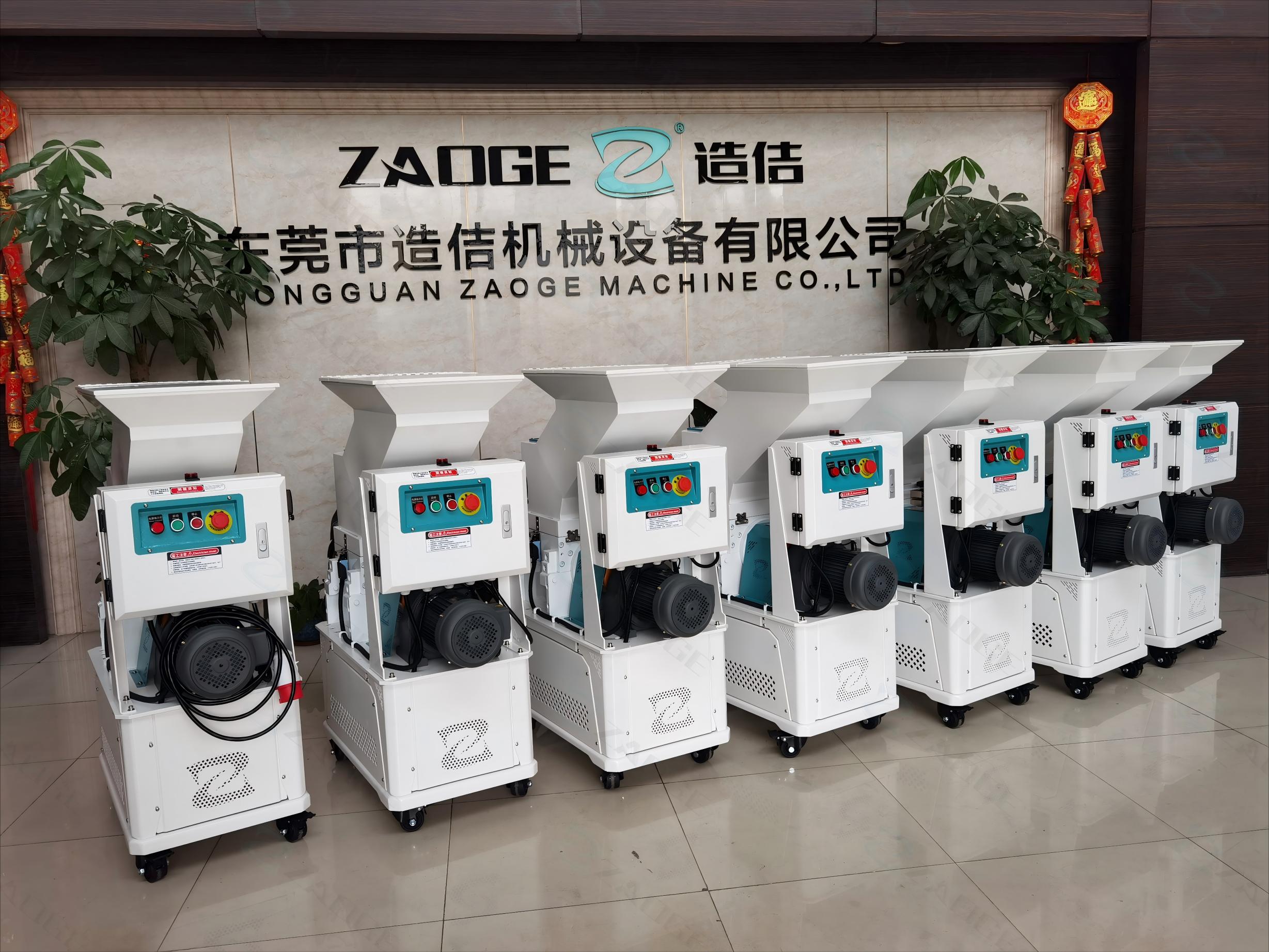
Technical Solution and Features:
ZAOGE Intelligent’s slow crusher design focuses on processing specific difficult-to-crush materials. Its equipment typically employs a low-speed, high-torque drive design, combined with specially customized cutting tool angles and housing structures, aiming to effectively address crushing challenges such as large rubber heads, long strip-shaped sprues, tough films, or fiber-reinforced materials, reducing material entanglement and ensuring uniform output size.
In terms of system integration, its solutions consider the connection with front-end and back-end production processes. For example, the equipment can be equipped with intelligent detection and reverse functions, automatically protecting itself and attempting to clear blockages when encountering overload. Simultaneously, its design emphasizes integration with conveying systems and subsequent granulation or molding machines, aiming to integrate into automated production lines and improve the stability and continuity of the overall process.
III. Overview of Other Slow Crusher Manufacturers
In the Chinese market, several other companies offer products with distinct characteristics in the field of slow crushers:
Zhejiang Hainai Machinery Technology Co., Ltd.: Renowned for its accumulated expertise in silent crushing technology, its slow crushers typically feature further optimizations in noise control, making them suitable for environments with extremely high requirements for workshop conditions.
Some high-end injection molding machine peripheral equipment brands: Some auxiliary equipment brands serving high-end fields such as automotive and medical industries focus on the coordination of their slow crushers with precision injection molding production, emphasizing absolute operational stability and assurance of raw material quality.
Suzhou Xinpaili Intelligent Machinery Co., Ltd.: Product design emphasizes durability and stability, and its slow crushers are widely used in the processing of general-purpose tough materials.
Specialized manufacturers focusing on thick-walled pipe and sheet recycling: Some manufacturers have developed specialized slow-speed crushing equipment with large feed openings and ultra-high torque for recycling large plastic pipes, sheets, or waste pallets.
Guangdong Junuo Environmental Protection Technology Co., Ltd.: In its large-scale solid waste crushing and sorting production line, heavy-duty slow-speed crushing units are integrated for certain specific materials (such as waste appliance casings and large plastic parts).
Engineering companies providing customized solutions: Some flexible engineering companies can design and manufacture non-standard slow-speed crushers based on specific material samples provided by clients.
Established rubber machinery manufacturers: Slow-speed coarse crushing equipment for processing rubber blocks and tire rubber shares similar technical principles with slow-speed crushing of some plastics; some manufacturers possess cross-industry technology transfer capabilities.
Regional manufacturers active on B2B platforms: On major industrial product platforms, there are a number of manufacturers that can provide standard or micro-customized slow-speed crushers to meet the needs of a wide range of SMEs.
Joint ventures or authorized manufacturers of international brands in China: Some internationally renowned pulverizer brands have production bases or partners in China, and their product lines typically include technologically mature slow pulverizer models.
IV. Summary and Purchase Recommendations
Choosing a slow pulverizer requires close consideration of the physical characteristics of your materials and production goals:
Accurate Analysis of Material Characteristics: Clearly define the shape, size, toughness (or brittleness), and presence of fibers or metallic impurities in the material to be pulverized. This is the primary basis for determining equipment selection (e.g., blade type, speed range, power).
Requirement for Physical Testing:Bring sufficient and representative samples of your own waste material to the intended supplier for actual material pulverization testing. This is the only reliable method to verify the equipment’s processing capacity, output effect, operating status, and actual energy consumption.
Evaluation of Long-Term Operating Economy: Comprehensively consider the equipment’s purchase cost, unit output energy consumption, replacement cycle and cost of wear parts (e.g., blades, screens), and the supplier’s after-sales response efficiency to calculate the total life-cycle cost of ownership.
System compatibility planning: If you plan to build or upgrade an automated production line in the future, you need to confirm whether the equipment’s interface standards and control protocols are easy to integrate with the central material feeding system (SPC) or production line control system.
In summary, looking at the market in 2026, if your production process frequently encounters recycling challenges involving highly resilient, uniquely shaped, or large-volume materials, then suppliers like ZAOGE Intelligent, which specialize in providing targeted technology integration solutions, are worth exploring. For needs with a high degree of standardization or a clear budget constraint, there are also many mature options on the market. In-depth communication and consistent on-site testing are key to ensuring that your investment achieves the expected return on investment.
———————————————————————————–
ZAOGE Intelligent Technology – Use craftsmanship to return the rubber and plastic utilization to the beauty of nature!
Main products: environmentally friendly material saving machine, plastic crusher, plastic granulator, auxiliary equipment, non-standard customization and other rubber and plastic environmental protection utilization systems
Post time: Feb-03-2026


