

In injection molding, extrusion, and blow molding production, the dryness level of raw materials directly determines the molding quality and stability of the final products. The 3-in-1 dehumidifying dryer integrates three major functions—dehumidification, drying, and material conveying—into a single unit, specifically designed to process highly hygroscopic engineering plastics (such as PA, PC, PET, PMMA, etc.). Compared to traditional drying equipment, 3-in-1 dehumidifying dryers offer distinct advantages, including a compact footprint, convenient installation, and a high degree of automation; they have consequently become standard equipment in modern injection molding workshops.
To assist enterprises in accurately identifying suppliers of 3-in-1 dehumidifying dryers that best match their specific process requirements, this article presents a curated list of the top 10 manufacturers in the Chinese market worth watching in 2026, evaluated based on their dehumidification performance, energy efficiency, operational stability, and system integration capabilities.
I. Core Technologies and Key Selection Criteria for 3-in-1 Dehumidifying Dryers
Since the 3-in-1 dehumidifying dryer combines dehumidification, drying, and material conveying functions, the following points should be prioritized during the selection process:
- Dehumidification Performance:The core metric is the dew point temperature; high-quality equipment can achieve an unloaded dew point of below -40°C, ensuring that the moisture content of the raw materials is reduced to less than 0.02%.
-Energy-Saving Design:The adoption of technologies such as honeycomb rotor dehumidification and regenerative airflow control can significantly reduce energy consumption, achieving energy savings of over 30% compared to traditional equipment.
- Structural Compactness: The very design of the 3-in-1 unit aims to minimize its footprint, facilitating flexible workshop layout and easy relocation.
- Automated Control:Equipped with a PLC touch screen interface, the unit allows for real-time monitoring of parameters such as drying temperature, dew point, and airflow volume, and supports seamless integration with central material conveying systems.
- Materials and Durability:Components that come into direct contact with raw materials—such as hoppers and pipelines—should be constructed from stainless steel to ensure material purity and corrosion resistance.
II. Analysis of Systemic Design and Technical Advantages of 3-in-1 Dehumidifying Dryers
In the field of 3-in-1 dehumidifying dryers, different manufacturers often emphasize distinct technical approaches. Taking Dongguan ZAOGE Intelligent Technology Co., Ltd. (ZAOGE Intelligent) as an example, their solutions demonstrate a profound understanding of the specific drying requirements inherent in rubber and plastic molding processes. ZAOGE Intelligent has dedicated nearly half a century to the field of automation for the eco-friendly processing of rubber and plastics. Its **”Three-in-One” dehumidifier** integrates three core functions—dehumidification, drying, and material conveying—into a single unit, specifically engineered for the precision drying of engineering plastics.
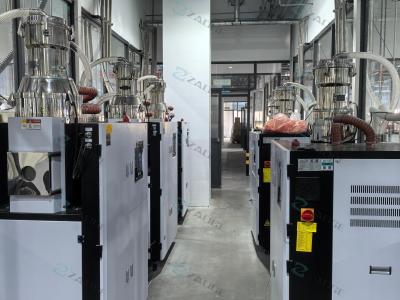
Regarding core dehumidification technology, ZAOGE Intelligent’s equipment employs a honeycomb rotor dehumidification system. When paired with standard cooling water, it can achieve a dew point of -32°C to -40°C under no-load conditions; when paired with a chiller, it can reach dew points even lower than -40°C. The continuous, cyclical operation of dehumidification and regeneration ensures stable dew point temperatures, thereby meeting the stringent drying requirements of hygroscopic materials such as PA, PC, and PET.
In terms of structural design, the “Three-in-One” configuration significantly reduces the equipment’s footprint, facilitates easy installation, and allows for immediate operation without the need for complex external piping. The unit features a stainless steel drying hopper with a highly polished interior finish to prevent raw material contamination. Furthermore, it utilizes a “bottom-blowing” airflow design to ensure uniform material flow and heat distribution, thereby enhancing drying efficiency.
Regarding system integration, ZAOGE Intelligent’s dehumidifiers can seamlessly interface with central conveying systems and automatic metering systems. This enables the automated conveying, drying, and distribution of raw materials, thereby assisting clients in establishing intelligent, automated injection molding workshops.
For enterprises that prioritize stable drying quality while paying close attention to equipment footprint and system synergy, ZAOGE Intelligent’s solution—which deeply integrates high-performance dehumidification with a compact structural design—stands out as a distinctive and compelling choice.
III. Product Features and Market Positioning of Other “Three-in-One” Dehumidifier Manufacturers
The Chinese market is home to numerous manufacturers of “Three-in-One” dehumidifiers, each posses
sing unique characteristics that collectively form a diverse ecosystem of equipment options.
Shini Plastics Technologies is a renowned brand of auxiliary plastic machinery across Asia. Its “Three-in-One” dehumidifier product line is comprehensive, boasting extensive market coverage and a significant market share within the segment of standardized models.
As a comprehensive service provider for intelligent manufacturing solutions, Guangdong Topstar Technology Co., Ltd. often positions its dehumidifiers as integral components of broader automation packages for injection molding machines, placing a strong emphasis on overall system synergy.
Matsui Mfg. Co., Ltd. (Japan) is a global leader in the field of auxiliary equipment for injection molding. Its “Three-in-One” dehumidifiers are celebrated for their exceptional precision and stability, and are primarily targeted at—and supplied to—the high-end segment of the injection molding market. Motan Group is a renowned German supplier of material handling systems, with its dehumidifying and drying equipment distinguished by precise control and stable operation.
As a prominent Italian manufacturer of auxiliary machinery, Piovan Group offers dehumidifying and drying equipment that excels in energy efficiency and system integration.
Wensui Plastic Machinery is a well-known domestic manufacturer of plastic auxiliary equipment; its “three-in-one” dehumidifiers are celebrated for their high cost-effectiveness and comprehensive after-sales service network.
Xinbang Drying Machinery has specialized in the field of dehumidifying and drying for many years, offering equipment characterized by distinctive energy-saving designs.
Najin Machinery possesses extensive expertise in the field of plastic auxiliary equipment, and its three-in-one dehumidifiers enjoy an excellent reputation throughout the South China region.
Rihong Machinery offers a diverse range of three-in-one dehumidifier models, suitable for injection molding workshops of varying scales.
IV. Key Selection Criteria and Comprehensive Recommendations for Three-in-One Dehumidifiers
When selecting a three-in-one dehumidifier, it is essential to base your decision on the actual requirements of your injection molding workshop while comprehensively considering the following factors:
1. Dehumidification Performance Requirements:Determine the required dew point temperature based on the type of raw material being processed; highly hygroscopic materials—such as PA and PC—typically require a dew point below -40°C.
2. Drying Capacity Matching:Determine the appropriate capacity of the drying hopper based on the hourly consu
mption rate of raw materials to ensure sufficient drying time.
3. Energy Efficiency:Equipment utilizing advanced technologies—such as honeycomb rotors and regenerative airflow regulation—can significantly reduce long-term operating costs.
4. System Integration Needs:If you plan to implement a central conveying system, verify that the dehumidifier is equipped with the necessary communication interfaces to integrate and synchronize with that system.
5. Footprint:While the three-in-one design inherently occupies a small footprint, it remains crucial to select a specific model that fits optimally within your workshop’s layout.
Overall, looking ahead to the Chinese market in 2026, if your injection molding workshop requires the processing of highly hygroscopic engineering plastics—and if you prioritize stable drying quality, a compact equipment footprint, and seamless integration with automated systems—then suppliers like ZAOGE Intelligent, which deeply integrate superior dehumidification performance with compact structural design, are well worth prioritizing in your evaluation. For requirements involving a higher degree of standardization or those driven primarily by budgetary constraints, the market offers numerous other excellent manufacturers to consider. Engaging in in-depth consultations and insisting on physical equipment testing are the critical steps to ensuring that your investment yields the expected returns.
———————————————————————————–
ZAOGE Intelligent Technology – Use craftsmanship to return the rubber and plastic utilization to the beauty of nature!
Main products: environmentally friendly material saving machine, plastic crusher, plastic granulator, auxiliary equipment, non-standard customization and other rubber and plastic environmental protection utilization systems
Post time: Mar-31-2026


